
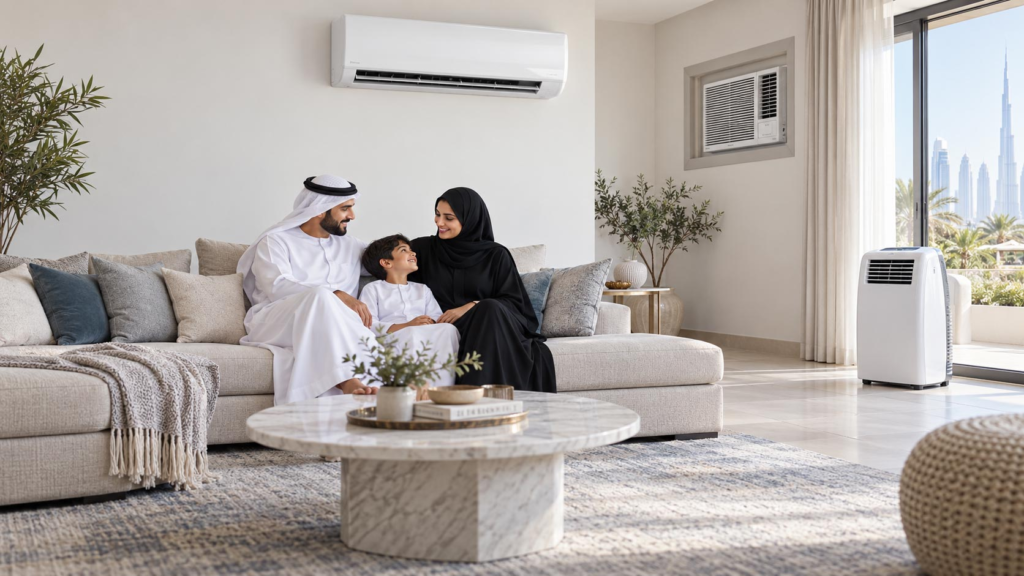
Choosing the right air conditioner for your home in the UAE is not only about buying the biggest or most powerful unit. The right AC should match your room size, daily cooling needs, available installation space, and energy-saving priorities.
With the UAE’s long and hot summers, an air conditioner that is too small may struggle to cool the room and run continuously. An oversized unit may cool quickly but switch on and off too often, resulting in uneven comfort and unnecessary energy use.
This guide explains the differences between split, window, and portable air conditioners, how to estimate the right cooling capacity for your room, and which features are worth considering before you buy.
Why Choosing the Right Air Conditioner Matters in the UAE
Air conditioning is an essential part of everyday home comfort in the UAE. However, choosing the right unit is not simply about buying the most powerful model. The air conditioner should match the size of the room, the available installation space, and your household’s daily cooling needs.
An undersized AC may struggle to reach the desired temperature and operate continuously. On the other hand, an oversized unit may cool the room too quickly without managing comfort efficiently, leading to frequent switching and unnecessary energy consumption.
Choosing the correct type and capacity can provide more consistent cooling, improve energy efficiency, and help the air conditioner perform reliably over time.
Split, Window, or Portable AC: Which Type Is Right for Your Home?
Each type of air conditioner offers different advantages depending on the room, installation requirements, and how the space is used. Split ACs are commonly chosen for bedrooms and living areas, while window and portable units can be practical for homes or accommodations where installation options are limited.
Understanding the differences will help you choose a cooling system that fits your home and daily needs.
Split Air Conditioners
Split air conditioners are a popular choice for bedrooms, living rooms, and other frequently used areas of the home. They use separate indoor and outdoor units, allowing them to provide effective cooling with quieter indoor operation.
A split AC is a good option when permanent installation is possible and you want consistent cooling for daily use. Depending on the model, features may include inverter technology, self-cleaning functions, copper components, and corrosion-resistant protection designed for demanding weather conditions.
Best for: Bedrooms, living rooms, family rooms, and regularly used indoor spaces.
Window Air Conditioners
Window air conditioners combine the cooling components into a single compact unit. They can be a practical choice for rooms with a suitable wall opening and where a complete split AC installation may not be possible.
These units are commonly used in bedrooms, smaller homes, staff accommodation, and rooms that require straightforward cooling. Before choosing one, check the available installation space, cooling capacity, noise level, and power requirements.
Best for: Bedrooms, smaller rooms, accommodation units, and spaces with an existing AC opening.
Portable Air Conditioners
Portable air conditioners are movable cooling units that can be used without permanent wall-mounted installation. Most models require an exhaust hose to release warm air outside through a window, door opening, or suitable vent.
They are useful for renters, temporary cooling, or rooms where installing a split or window AC is not practical. However, they may be less efficient and slightly noisier than fixed air-conditioning systems, so room size and ventilation should be considered carefully.
Best for: Rental homes, temporary use, smaller rooms, and spaces where permanent installation is restricted.
How to Choose the Right AC Capacity for Your Room
Choosing the correct cooling capacity is one of the most important steps when buying an air conditioner. AC capacity is commonly expressed in BTU per hour or tons, with one ton of cooling equal to approximately 12,000 BTU per hour.
The appropriate capacity depends on more than room size. Ceiling height, sunlight exposure, insulation, number of occupants, windows, and heat-producing appliances can all affect how much cooling a room requires.
A unit that is too small may run continuously without cooling the room properly. A unit that is too large may switch on and off frequently. For the best result, use room size as a starting point and confirm the final capacity with a qualified AC supplier or technician.
Factors That Affect the Required AC Capacity
When estimating the appropriate AC capacity, consider the following factors:
- Room size: Larger rooms generally require greater cooling capacity.
- Ceiling height: High ceilings increase the volume of air that must be cooled.
- Sunlight exposure: Rooms receiving strong afternoon sunlight may require additional cooling.
- Windows and insulation: Large windows, air leakage, and poor insulation allow more heat to enter.
- Number of occupants: More people inside the room produce additional heat.
- Room use: Kitchens and rooms containing heat-producing appliances may need higher cooling capacity.
- Floor level: Upper-floor rooms can become warmer because of heat absorbed by the roof.
These factors explain why two rooms with similar floor areas may require different AC capacities.
Factors That Affect the Required AC Capacity
The main difference between inverter and non-inverter air conditioners is how the compressor operates.
An inverter AC automatically adjusts the compressor speed according to the cooling required. Instead of repeatedly switching fully on and off, it can operate at a lower speed after reaching the desired temperature. This may provide more consistent cooling, quieter operation, and better energy efficiency during regular or extended use.
A non-inverter AC uses a fixed-speed compressor that switches on and off to maintain the selected temperature. It may have a lower initial purchase cost and can still be practical for rooms used only occasionally. However, it may consume more electricity when operated for long periods.
For bedrooms, living rooms, and other frequently used spaces, an inverter AC is generally the more energy-efficient choice. For occasional or short-term cooling, a non-inverter model may still be suitable.
Important Features to Consider When Buying an AC
Beyond AC type and cooling capacity, the right features can improve comfort, durability, and everyday convenience. Features vary by model, so always confirm the specifications before purchasing.
- 100% copper components: Copper tubing can provide reliable heat transfer and is generally easier to maintain and repair.
- Gold Fin protection: A protective coating on the heat exchanger may help improve resistance against corrosion and demanding weather conditions.
- Rotary compressor: Designed to provide effective cooling with smoother and quieter operation.
- Self-cleaning function: Helps reduce moisture and dust buildup inside the indoor unit, supporting cleaner operation and easier maintenance.
- Energy-saving operation: Look for inverter technology and an appropriate energy-efficiency rating, especially when the AC will run for several hours each day.
- Noise level: A quieter indoor unit is particularly important for bedrooms, nurseries, and study areas.
- Warranty coverage: Check the separate warranty periods for the compressor and the complete unit, together with the applicable terms and conditions.
Choose features based on how often the room is used rather than selecting a unit only because it has the longest feature list.
How to Improve AC Energy Efficiency at Home
Choosing an energy-efficient air conditioner is only the first step. The way the unit is installed, operated, and maintained also affects electricity consumption and cooling performance.
- Choose the correct capacity: An appropriately sized AC can cool the room without operating continuously or switching on and off too frequently.
- Keep doors and windows closed: Preventing warm air from entering helps the room maintain a comfortable temperature.
- Use curtains or blinds: Reducing direct sunlight can lower the amount of heat entering the room.
- Clean the filters regularly: Dusty filters restrict airflow and make the air conditioner work harder.
- Avoid extremely low temperature settings: Select a comfortable and consistent temperature instead of forcing the unit to cool the room unnecessarily.
- Arrange regular maintenance: Cleaning the coils, checking refrigerant levels, and inspecting the system can help maintain efficient operation.
Good daily habits can improve cooling comfort while helping reduce unnecessary energy use.
Which Type of AC Is Best for Different Rooms?
Different areas of the home may require different cooling solutions. Consider the room’s size, frequency of use, heat exposure, and available installation space.
- Bedroom: A quiet split AC is usually suitable for comfortable overnight cooling. A window AC may also be practical when a split installation is unavailable.
- Living room: A properly sized split AC can provide consistent cooling for a larger space used by several family members.
- Small room or home office: A compact split, window, or portable AC may be suitable depending on the installation restrictions and daily usage.
- Kitchen: Additional heat from cooking appliances should be considered when calculating the required capacity. Proper ventilation is also important.
- Rental home: Check the landlord’s installation rules before drilling walls or modifying windows. A portable AC may be considered when permanent installation is not allowed.
- Staff accommodation: Window air conditioners can provide a straightforward cooling solution when suitable wall openings and electrical connections are available.
Always confirm the final capacity and installation requirements with a qualified supplier or technician.
Common Mistakes to Avoid When Buying an Air Conditioner
Avoiding common buying mistakes can help you choose an AC that provides reliable comfort and suits your home.
- Choosing based only on price: A lower purchase cost may not provide the best value if the unit is inefficient or unsuitable for the room.
- Buying the wrong capacity: A bigger AC is not automatically better. Both undersized and oversized units can affect comfort and efficiency.
- Ignoring installation requirements: Check the available space, electrical supply, drainage, ventilation, and permission from the property owner before purchasing.
- Overlooking energy efficiency: Consider how frequently and how long the AC will operate, especially in bedrooms and living rooms.
- Ignoring the noise level: A powerful unit may still be unsuitable if it is too noisy for sleeping or studying.
- Not checking warranty terms: Confirm what is covered, how long the compressor and complete unit are protected, and whether any conditions apply.
- Skipping professional advice: Room size alone may not determine the correct capacity. Sunlight, insulation, windows, ceiling height, and occupancy should also be evaluated.
Taking time to compare the correct specifications can help prevent poor cooling performance and unnecessary operating costs.
Frequently Asked Questions About Choosing an AC in the UAE
A split AC is generally suitable for bedrooms and living rooms that require regular cooling. Window units can be practical for rooms with an existing AC opening, while portable units are useful where permanent installation is restricted.
Measure the room and consider ceiling height, sunlight, windows, insulation, occupancy, and room use. Room size provides a starting point, but the final capacity should be confirmed by a qualified AC supplier or technician.
An inverter AC can provide more consistent cooling and better energy efficiency during extended daily use. A non-inverter unit may still be practical for rooms that require only occasional cooling.
Most portable air conditioners require an exhaust hose to release warm air outside. Without proper ventilation, the unit may struggle to cool the room effectively.
Check the AC type, cooling capacity, energy efficiency, noise level, installation requirements, available features, and warranty coverage. The unit should match the room and your household’s daily cooling needs.
Find the Right Air Conditioner for Your Home
The best air conditioner for your home in the UAE depends on the room size, installation space, daily usage, and the features that matter most to your household. Comparing these factors carefully can help you achieve comfortable and reliable cooling without choosing an unnecessarily large or unsuitable unit.
BAE.AE offers air-conditioning options for different home requirements, including split, window, and portable air conditioners. Contact our team for product information and assistance in selecting a suitable AC for your space.